“Though women in post-Independent India have excelled in various fields, the social attitude towards women and feminist movement has been patriarchal.” Apart from women education and women empowerment schemes, what interventions can help change this milieu? (UPSC 2021)
Women in India have excelled in many fields, yet patriarchal attitudes still shape family, workplace and public life. Changing this requires interventions that alter power relations, not just expand opportunities.
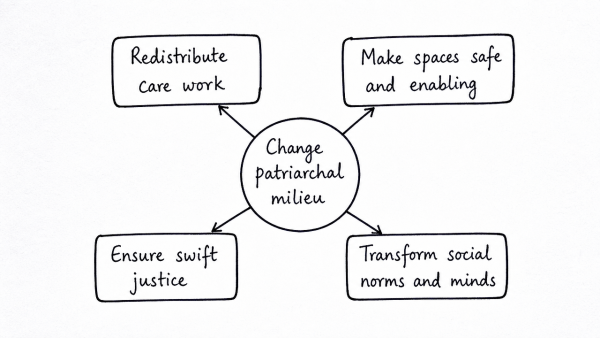
- Redistribute care work: A national care policy, affordable crèches, elder care, shared parenting, paid paternity leave and parental leave can reduce women’s unpaid burden.
- Make spaces safe and enabling: Safe transport, street lighting, workplace safety, flexible work, and effective complaint systems can raise women’s participation and autonomy.
- Ensure swift justice: Fast-track action in cases of violence, harassment and discrimination, with gender-sensitised police, judiciary and local officials, can reduce fear and impunity.
- Increase real representation: Women’s presence in legislatures, parties, local bodies and institutions must mean decision-making power, not proxy control.
- Challenge stereotypes: Gender-sensitive textbooks, responsible media, anti-sexist advertising, civic education and sports can reshape norms from childhood.
- Engage men and communities: Allyship programmes, parenting education and community campaigns can normalise shared domestic roles and reject male privilege.
- Boost economic agency: Joint property titles, access to credit and support for women-led enterprises strengthen bargaining power within households.
Thus, patriarchy can be weakened only by combining legal reform, institutional accountability, economic independence and social re-education to make equality a lived norm.
Originally written on
September 2, 2026
and last modified on
September 2, 2026.