Though the federal principle is dominant in our Constitution and that principle is one of its basic features, but it is equally true that federalism under the Indian Constitution leans in favour of a strong Centre, a feature that militates against the concept of strong federalism. Discuss. (UPSC 2014)
Indian federalism is real and constitutionally significant, but it is not of the classical “strong federal” type. The Constitution combines a federal framework with a clear tilt towards the Centre to preserve unity, integrity and effective governance in a diverse country.
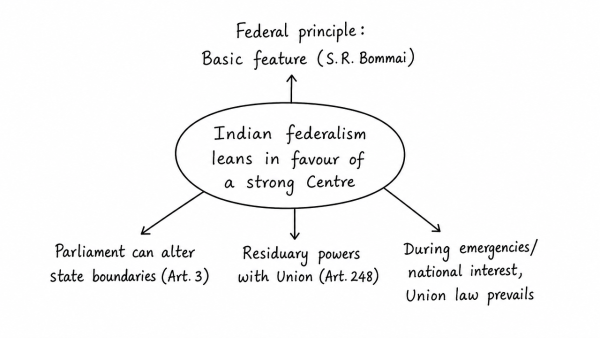
- Federal principle as basic feature: The Supreme Court in S.R. Bommai held federalism to be part of the basic structure.
- Strong Centre provisions: Parliament can alter state boundaries under Article 3; residuary powers lie with the Union under Article 248; and in emergencies or national interest, Union law can prevail over state law.
- Centre over States: Article 356 permits President’s Rule, while Governors and central agencies often become flashpoints in Centre-State relations.
- Fiscal tilt: The Union controls cesses, surcharges and major tax policy, affecting state autonomy. Yet recent rulings such as on mineral royalties and Article 131 show judicial protection of federal space.
Thus, India is best described as a cooperative but centrally tilted federation, not a weak unitary system nor a fully strong federal one.
Originally written on
August 29, 2026
and last modified on
August 29, 2026.