Though Citizens’ charters have been formulated by many public service delivery organizations, there is no corresponding improvement in the level of citizens’ satisfaction and quality of services being provided. Analyse. (UPSC 2013)
Citizens’ Charters were meant to make public services predictable, transparent and citizen-friendly. However, in practice they have often remained moral promises rather than enforceable guarantees, so satisfaction has not risen significantly.
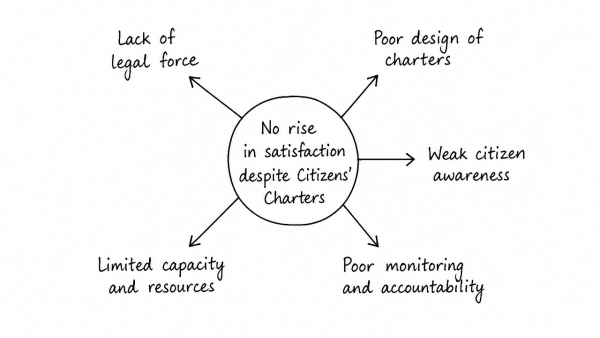
- Lack of legal force: Most charters are non-binding, with no clear penalty or compensation for failure.
- Poor design: They are often drafted top-down, with vague, unrealistic and outdated service standards.
- Weak awareness: Many citizens do not know the charter exists, so they cannot use it effectively.
- Limited capacity: Shortage of staff, funds, digital tools and basic infrastructure delays delivery.
- Weak accountability: Grievance redress is slow, and performance is rarely audited independently.
| Way forward | Make charters legally backed, citizen-driven, time-bound and linked to penalties, service audits and real-time grievance systems. |
Thus, Charters alone cannot improve service quality unless supported by process reform, capacity building, public awareness and strict accountability. They must become living instruments of service delivery, not decorative documents.
Originally written on
August 28, 2026
and last modified on
September 7, 2026.