There is a clear acknowledgement that Special Economic Zones (SEZs) are a tool of industrial development, manufacturing and exports. Recognizing this potential, the whole instrumentality of SEZs requires augmentation. Discuss the issues plaguing the success of SEZs with respect to taxation, governing laws and administration. (UPSC 2015)
Special Economic Zones were meant to create export-led manufacturing clusters, attract investment and generate jobs. Yet their impact has been weaker than expected because fiscal incentives, legal design and day-to-day administration have not worked in harmony.
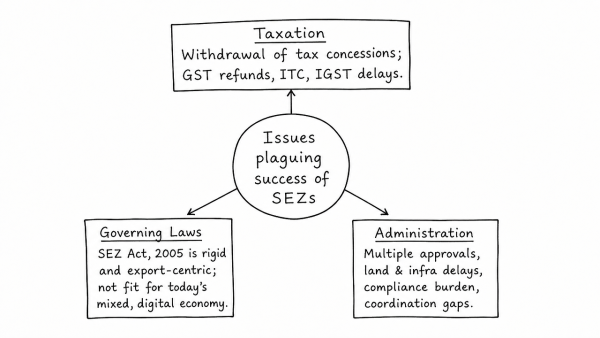
- Taxation: Withdrawal of income-tax concessions, along with MAT and DDT, reduced the original attraction of SEZs. Under GST, zero-rating exists in theory, but refunds, input tax credit issues and IGST compliance add cost and delay.
- Governing laws: The SEZ Act, 2005 is export-centric and rigid. It does not suit today’s mixed market, digital and service-led economy. The lack of smooth transition to a more flexible framework has created uncertainty for investors.
- Administration: Multiple authorities, weak single-window clearance, poor coordination between Centre and States, and slow customs and regulatory approvals raise transaction costs. Large land parcels also remain underused.
Thus, SEZs need a more stable tax regime, simpler laws and truly integrated governance. Without these reforms, they will remain enclaves of promise rather than engines of industrial growth.
Originally written on
August 30, 2026
and last modified on
August 30, 2026.