“There arose a serious challenge to the Democratic State System between the two World Wars.” Evaluate the statement. (UPSC 2021)
Yes, the interwar years posed a grave challenge to the democratic state system, though democracy did not collapse everywhere. The period became a testing ground in which authoritarian and totalitarian alternatives gained strength.
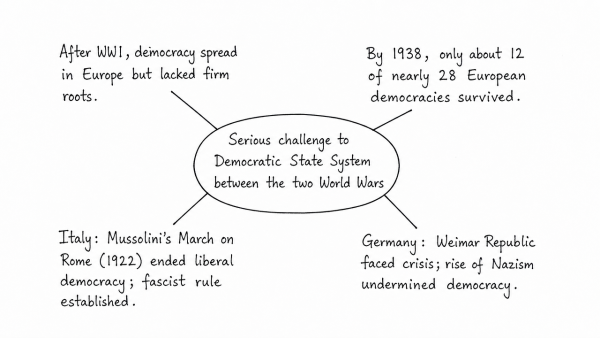
- Why the challenge was serious
- After World War I, democracy spread in Europe, but many new regimes lacked firm social and institutional roots; by 1938, only about 12 of nearly 28 European democracies of 1920 survived.
- In Italy, Mussolini’s March on Rome (1922) and subsequent laws destroyed liberal democracy and established fascist rule.
- In Germany, the Weimar Republic was weakened by Article 48 and ended with Hitler’s legal rise through the Enabling Act (1933).
- In Japan, militarist forces ended the Taishō democratic phase and pushed expansionism.
- The Great Depression deepened unemployment, poverty and resentment; in Germany, unemployment crossed 30% in 1932, aiding extremist appeal.
- The League of Nations failed to restrain aggression in Manchuria and Abyssinia, weakening faith in collective security.
- Why democracy survived in some states
- Older democracies like Britain, France, the United States and the Nordic countries endured due to stronger institutions, political traditions and social support.
- Some adapted through reform, such as the New Deal in the United States and welfare measures in Sweden.
Thus, the statement is valid: between the two world wars democracy faced its most dangerous crisis, but its survival in several countries showed that institutional depth and reform capacity could preserve it.
Originally written on
September 2, 2026
and last modified on
September 2, 2026.