The World Bank and the IMF, collectively known as the Bretton Woods Institutions, are the two inter-governmental pillars supporting the structure of the world’s economic and financial order. Superficially, the World Bank and the IMF exhibit many common characteristics, yet their role, functions and mandate are distinctly different. Elucidate. (UPSC 2013)
The World Bank and the IMF are Bretton Woods institutions created in 1944, sharing membership, governance links and a role in global economic stability, but they differ sharply in mandate and functions.
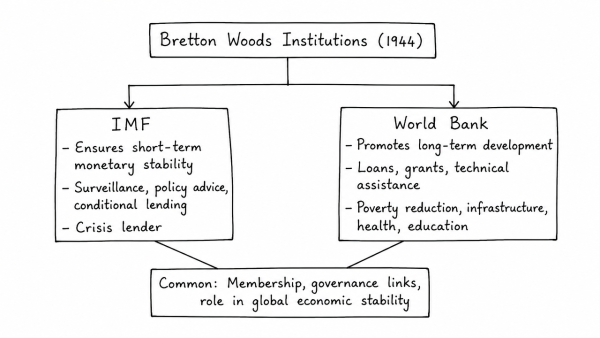
- IMF: It ensures short-term monetary and balance-of-payments stability through surveillance, policy advice and conditional lending to countries facing currency, inflation or fiscal crises.
- World Bank: It promotes long-term development by financing reconstruction, poverty reduction, infrastructure, health, education and institutional capacity through loans, grants and technical assistance, mainly for developing countries.
- Nature: The IMF is a crisis lender and watchdog of macroeconomic policies; the World Bank is a development finance institution focused on project and structural support.
- Structure: The IMF is a single institution, while the World Bank Group comprises IBRD, IDA, IFC, MIGA and ICSID.
Thus, the IMF manages external stability, whereas the World Bank drives development and poverty alleviation.
Originally written on
August 28, 2026
and last modified on
September 7, 2026.