The third battle of Panipat was fought in 1761. Why were so many empire-shaking battles fought at Panipat? (UPSC 2014)
Panipat became a repeated theatre of decisive battles because it sat on the northern gateway to Delhi, the centre of imperial power. For invaders from Central Asia and Afghanistan, it was the easiest route into North India, while for rulers in Delhi it was the safest place to stop them before the capital was reached.
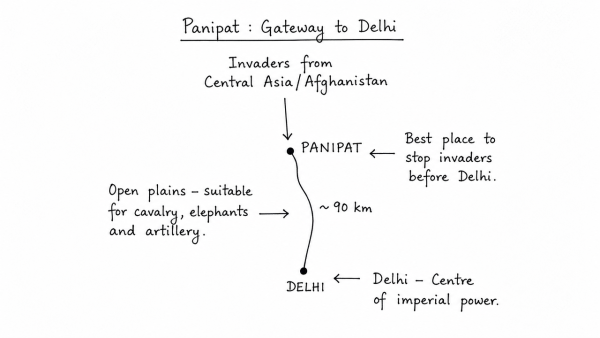
- Strategic location: It lies about 90 km from Delhi, giving defenders room to block advance without exposing the capital to immediate siege.
- Open plains: The flat terrain suited cavalry charges, war elephants and later artillery, making large-scale battles effective.
- Logistics: It was on the Grand Trunk Road, with good supply lines, water and fodder from the fertile Indo-Gangetic plain.
- Timing: Dry post-monsoon weather allowed armies to camp and manoeuvre for long periods.
Thus, Panipat combined geography, route control and military convenience, making it a natural battlefield for empire-shaking conflicts.
Originally written on
August 29, 2026
and last modified on
September 7, 2026.