The strength and sustenance of local institutions in India has shifted from their formative phase of ‘Functions, Functionaries and Funds’ to the contemporary stage of ‘Functionality’. Highlight the critical challenges faced by local institutions in terms of their functionality in recent times. (UPSC 2020)
Local institutions were first built around Functions, Functionaries and Funds; today, the real issue is whether they can perform effectively. Functionality means the capacity of panchayats and municipalities to plan, decide, deliver services and remain accountable.
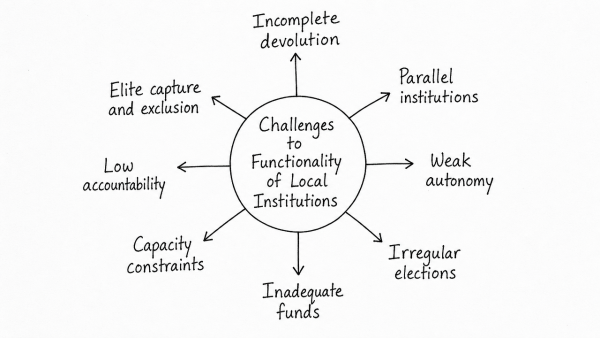
- Incomplete devolution: Many subjects in the 11th and 12th Schedules remain controlled by state departments, limiting local planning, land use, water supply and service delivery.
- Parallel institutions: Parastatals, development authorities and Smart City SPVs often bypass elected bodies, weakening democratic control and local accountability.
- Weak autonomy: Mayors are often ceremonial, tenures are short, and district administration frequently dominates rural local governance.
- Capacity gaps: Shortage of trained staff, engineers, accountants and planners reduces the ability to design projects, maintain records and implement schemes.
- Fiscal fragility: Local bodies depend heavily on grants, have low own revenue and often struggle with spending efficiency, accounting and compliance.
- Delayed institutional support: State Finance Commissions are often delayed or ignored, and audits are weak, harming fair devolution and oversight.
- Participation deficits: Proxy representation of women, elite capture of Gram Sabhas and low civic engagement reduce inclusiveness and responsiveness.
- Digital divide: Poor connectivity, limited data integration and weak digital skills constrain e-governance and transparency.
Thus, the key challenge is not mere existence of local institutions but their effective autonomy, capacity, finance and participatory accountability.
Originally written on
September 2, 2026
and last modified on
September 2, 2026.