The setting up of a Rail Tariff Authority to regulate fares will subject the cash strapped Indian Railways to demand subsidy for obligation to operate non-profitable routes and services. Taking into account the experience in the power sector, discuss if the proposed reform is expected to benefit the consumers, the Indian Railways or the private container operators. (UPSC 2014)
The Rail Tariff Authority can rationalise fares, but it will also reveal the true cost of socially necessary but unprofitable rail services. Experience of power regulation shows that independent tariff setting works only when subsidies for universal service obligations are explicit, timely and fully compensated.
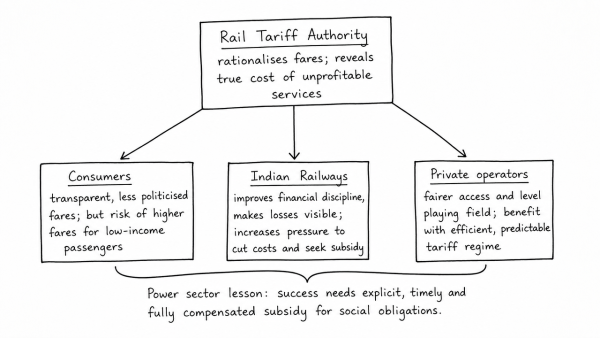
- Consumers: they gain from transparent, less politicised fare fixation and better accountability. But if cross-subsidy is cut sharply, low-income passengers may face higher fares.
- Indian Railways: it may improve financial discipline, reduce ad hoc pricing and make losses visible. Yet it will increase pressure to demand budgetary subsidy for loss-making routes.
- Private container operators: they are likely to benefit most if passenger losses are separated from freight pricing. Reduced cross-subsidy can lower freight charges and improve rail logistics competitiveness.
Overall, the reform benefits consumers and efficiency only with a credible subsidy regime; otherwise it mainly shifts the burden from hidden cross-subsidy to direct fiscal support.
Originally written on
August 29, 2026
and last modified on
August 29, 2026.