The role of individual MPs (Members of Parliament) has diminished over the years and as a result healthy constructive debates on policy issues are not usually witnessed. How far can this be attributed to the anti-defection law which was legislated but with a different intention? (UPSC 2013)
The anti-defection law was meant to curb political horse-trading and provide stable governments. However, its present use has often reduced MPs to party loyalists, weakening informed debate and independent judgement in Parliament.
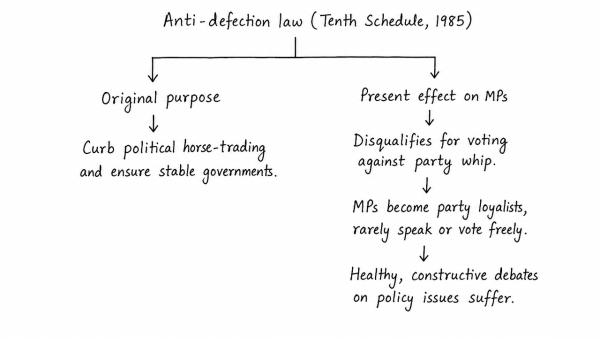
- Original purpose: The Tenth Schedule, added by the 52nd Amendment Act, 1985, sought to stop “Aya Ram Gaya Ram” defections and protect stability.
- Effect on MPs: Paragraph 2(1)(b) disqualifies an MP who votes against the party whip. Since whips are now issued even on ordinary Bills, MPs rarely speak or vote freely.
- Debate suffers: With party lines fixed in advance, MPs act more as numbers than as representatives. This weakens scrutiny, policy expertise and constructive disagreement.
- But not the only reason: Disruptions, rushed legislation, weak committee use and strong party control also reduce debate.
Thus, the anti-defection law has contributed substantially to the decline of individual MP autonomy, but the broader crisis of parliamentary deliberation also reflects deeper institutional and political trends. A narrower whip and stronger committee system can restore balance.
Originally written on
August 28, 2026
and last modified on
September 7, 2026.