The rock-cut architecture represents one of the most important sources of our knowledge of early Indian art and history. Discuss. (UPSC 2020)
Rock-cut architecture is a key source for early Indian art and history because it preserves in stone forms that once existed in wood, clay and other fragile materials, revealing artistic change, religion, patronage and trade.
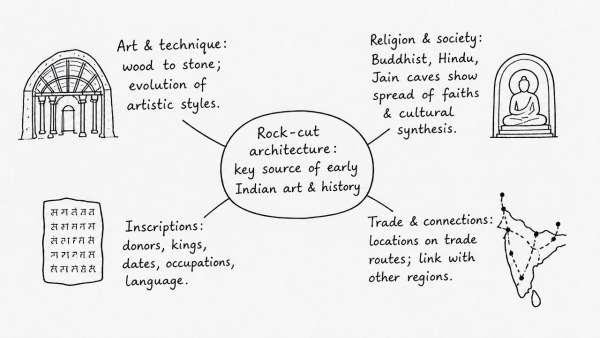
- Art and technique: Caves at Bhaja, Karle and Kanheri imitate timber structures, showing transition from wood to stone; Ajanta records the shift from aniconic to iconic Buddhist art, while Ellora and Mahabalipuram display peak carving skill.
- Religion and society: Buddhist, Hindu and Jain caves trace the spread of faiths and cultural synthesis. Inscriptions at sites like Nasik and Udayagiri mention merchants, guilds, women and rulers, reflecting social diversity and dynastic history. Their placement near trade routes such as Dakshinapatha shows links with commerce.
Thus, rock-cut architecture serves as a visual and epigraphic archive of early Indian society, economy, religion and state formation.
Originally written on
September 1, 2026
and last modified on
September 1, 2026.