The Right of Children to Free and Compulsory Education Act, 2009 remains inadequate in promoting incentive-based system for children’s education without generating awareness about the importance of schooling. Analyse. (UPSC 2022)
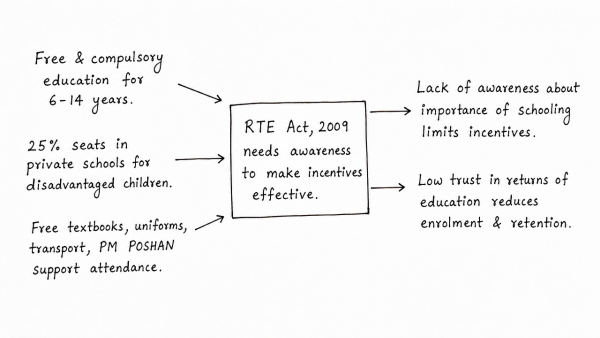
Article 21A and the RTE Act, 2009 made elementary education a justiciable right, and Section 12(1)(c) also created an incentive by reserving 25% seats in private unaided schools for disadvantaged children. Yet, mere provision of incentives cannot ensure schooling if families do not value education or trust its returns.
- Strengths of the Act
- Free and compulsory education for children aged 6-14 reduced direct cost barriers.
- Support measures such as free textbooks, uniforms, transport in remote areas and PM POSHAN help attendance.
- Judicial orders in recent years have reinforced that admissions under the 25% quota cannot be delayed or diluted.
- Why it remains inadequate
- Low awareness: Many poor and marginalised families are unaware of the 25% quota, or cannot use online admission systems.
- Poor learning outcomes: When schools fail to deliver basic literacy and numeracy, parents lose confidence in schooling.
- Dropout after Class 8: RTE covers only up to age 14, while the cost of secondary education rises sharply. This weakens continuity.
- Opportunity costs: Child labour, migration and household work often appear more urgent than education.
- Evidence of the gap
- Recent surveys show low reading levels in primary classes despite higher enrolment.
- Retention at the secondary stage remains weak, showing that access alone does not ensure completion.
- Way forward
- Expand free education in line with NEP 2020 up to age 18.
- Strengthen foundational learning through NIPUN Bharat.
- Use School Management Committees for door-to-door awareness.
- Run sustained parental and community campaigns on the long-term value of schooling.
Thus, the RTE Act is necessary but not sufficient. Without awareness, quality learning and social mobilisation, incentives remain underused and schooling fails to become a shared social aspiration.
Originally written on
September 3, 2026
and last modified on
September 3, 2026.