“The reservation of seats for women in the institutions of local self-government has had a limited impact on the patriarchal character of the Indian political process.” Comment. (UPSC 2019)
The reservation of seats for women in local self-government has undeniably widened political space for them, but its impact on patriarchy remains incomplete. It has increased numbers and visibility, yet unequal power relations, social control and proxy rule still limit real autonomy.
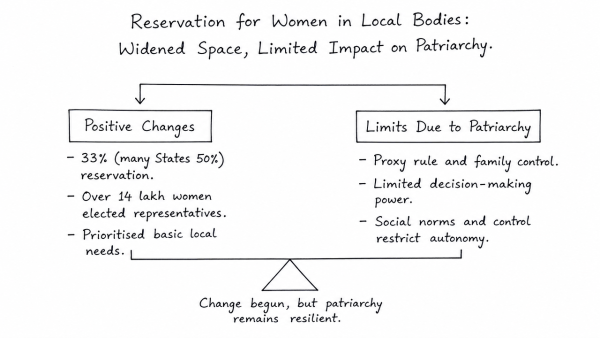
- Positive changes
- Article 243D and 243T provide for at least one-third reservation in Panchayats and Municipalities; many States have raised this to 50%.
- Over 14 lakh women now serve as elected representatives, making local bodies the largest platform of women’s political participation.
- Women leaders have often prioritised drinking water, sanitation, health and education, improving governance outcomes.
- In some States, women are even winning from unreserved seats, showing the rise of organic leadership.
- Why the impact is limited
- Patriarchal norms continue to shape candidate selection, campaigning and decision-making.
- The “sarpanch pati” culture reduces many elected women to nominal office-holders while male relatives exercise real authority.
- Low literacy, poor mobility, lack of training and control over funds weaken women’s effective participation.
- Social stigma and violence also discourage assertive leadership, especially in rural areas.
- Signs of deeper change
- Legal reservation has created a pipeline of leadership for women at the grassroots.
- Recent court and institutional efforts against proxy rule, along with capacity-building programmes, are slowly challenging entrenched male dominance.
Thus, reservation has altered the form of participation more than the substance of power. It has opened the door for women, but only sustained political training, social reform, strict action against proxy control and greater economic independence can fully weaken the patriarchal character of Indian politics.
Originally written on
September 1, 2026
and last modified on
September 1, 2026.