
The question of India’s Energy Security constitutes the most important part of India’s economic progress. Analyze India’s energy policy cooperation with West Asian countries. (UPSC 2017)
India’s energy security is central to growth because imported oil and gas power transport, industry, fertiliser and households. With dependence on imports for over 88% of crude oil, about half of natural gas and 60% of LPG, any disruption in West Asia quickly affects inflation, the current account and fiscal stability.
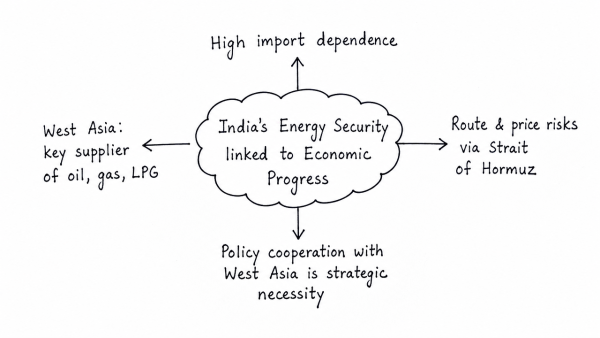
- Why West Asia matters: It supplies a large share of India’s crude, LNG and LPG, much of it through the Strait of Hormuz. Price shocks and route risks make cooperation with Gulf producers a strategic necessity, not just a commercial choice.
- UAE: storage and flexibility: India has deepened ties through strategic petroleum reserve cooperation. ADNOC’s participation in Indian SPRs and plans for offshore storage at Fujairah create a buffer against supply shocks and reduce dependence on a single route.
- Qatar: gas anchor: Long-term LNG contracts with Qatar ensure stable supply for India’s energy transition. At the same time, India has shown flexibility by diversifying spot cargoes when disruptions occur, reducing exposure to force majeure risks.
- Saudi Arabia: scale and transition: The Strategic Partnership Council and refinery cooperation support secure crude supplies and downstream capacity. Joint work on electricity interconnection, clean hydrogen and supply chains also links energy security with decarbonisation.
- Broader strategy: India has widened sourcing across more countries, improved shipping routes, and used commercial diplomacy to balance immediate hydrocarbon needs with future green energy partnerships.
Thus, India’s cooperation with West Asia is built on three pillars: assured supply, strategic storage and energy transition. The task ahead is to convert these ties into resilient, diversified and future-ready energy networks that support sustained economic growth.
Originally written on
August 31, 2026
and last modified on
August 31, 2026.
