The public expenditure management is a challenge to the Government of India in the context of budget making during the post-liberalization period. Clarify it. (UPSC 2019)
Public expenditure management means planning, allocating, spending and monitoring public funds efficiently, transparently and sustainably. In post-liberalisation India, it has become harder because the budget must support growth, welfare and macroeconomic stability in a market-oriented economy.
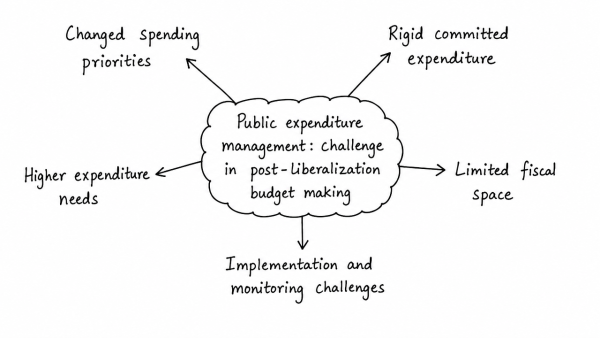
- Changed spending priorities: The State’s role shifted from direct production to regulation, infrastructure and social welfare. The abolition of the Plan/Non-Plan distinction made budgeting more rational, but also required focus on outcomes and quality of expenditure.
- Rigid committed expenditure: Interest payments, salaries, pensions and defence absorb a large share of revenue, leaving limited fiscal space for capital spending that boosts growth and jobs.
- Weak resource mobilisation: India’s tax-to-GDP ratio remains modest, constraining the financing of large welfare and infrastructure programmes without widening deficits.
- Subsidy and social spending pressures: Food, fertiliser and fuel subsidies are politically sensitive and often crowd out productive expenditure, especially during inflation or supply shocks.
- Fiscal discipline and transparency issues: Though FRBM aims to contain deficits, off-budget borrowings and hidden liabilities can obscure the true fiscal position.
- Implementation gaps: Delays in release, weak procurement, limited capacity at subnational levels and poor absorption lead to unspent balances and underutilised schemes.
Thus, the challenge is to spend more, spend better and spend transparently through stronger fiscal rules, higher capital outlay, better subsidy targeting, real-time monitoring and improved administrative capacity.
Originally written on
September 1, 2026
and last modified on
September 1, 2026.