The process of desertification does not have climate boundaries. Justify with examples. (UPSC 2020)
Desertification is not confined to hot deserts. It is a process of land degradation that can occur wherever vegetation is removed, soils are eroded, and moisture balance is disturbed, from humid tropics to cold mountains and temperate plains.
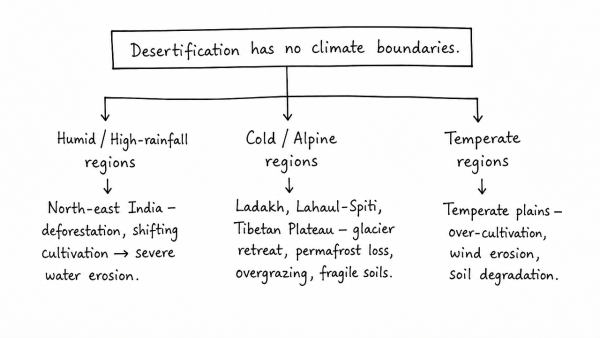
- Humid and high-rainfall regions: In north-east India, heavy rainfall on deforested hill slopes and shifting cultivation cause severe water erosion, exposing barren rock and poor soil.
- Cold and alpine regions: Ladakh, Lahaul-Spiti and the Tibetan Plateau face land degradation due to glacier retreat, permafrost loss, overgrazing and fragile soils.
- Temperate regions: The Dust Bowl in the Great Plains of the USA showed how over-cultivation and drought can turn fertile land into dust.
- Other examples: Parts of the Amazon are degrading through logging, burning and cattle ranching; the Loess Plateau in China suffered severe gully erosion.
Thus, desertification has no fixed climate boundary. It is driven more by human pressure, land misuse and climate stress than by aridity alone, making all ecosystems vulnerable.
Originally written on
September 2, 2026
and last modified on
September 2, 2026.