The ‘Powers, Privileges and Immunities of Parliament and its Members’ as envisaged in Article 105 of the Constitution leave room for a large number of un-codified and un-enumerated privileges to continue. Assess the reasons for the absence of legal codification of the ‘parliamentary privileges’. How can this problem be addressed? (UPSC 2014)
Article 105 protects Parliament’s functions, but it also leaves many privileges undefined. This ambiguity has survived because Parliament has preferred flexibility over fixed rules, while avoiding legal limits on its own powers.
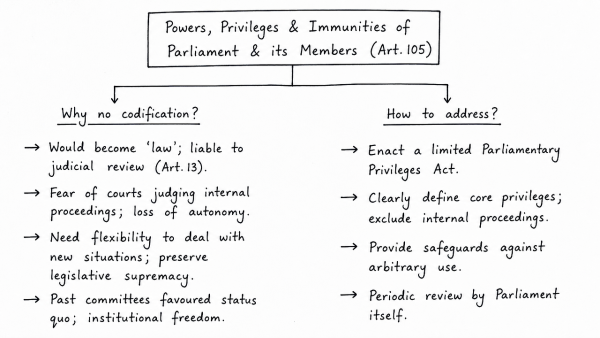
- Reasons for no codification: Codified privileges would become “law” and face judicial review under Article 13.
- Parliament fears loss of autonomy if courts start judging internal proceedings.
- Unwritten privileges allow quick response to new situations and preserve legislative supremacy.
- Past committees have also favoured status quo, citing institutional freedom.
- How to address it: Enact a limited Parliamentary Privileges Act defining only core, essential privileges.
- Exclude corruption, bribery and other ordinary crimes from immunity.
- Provide clear procedure, fair hearing and proportional penalties for breach cases.
- Follow a model that balances dignity of the House with fundamental rights and judicial scrutiny.
Thus, codification need not weaken Parliament; done carefully, it can reduce abuse, remove uncertainty and strengthen democratic accountability.
Originally written on
August 29, 2026
and last modified on
August 29, 2026.