The political and administrative reorganization of states and territories has been a continuous ongoing process since the mid-nineteenth century. Discuss with examples. (UPSC 2022)
Political and administrative reorganisation of India has never been a one-time exercise. From colonial rearrangements in the nineteenth century to recent creation and merger of Union territories, the map of India has been repeatedly altered to meet changing political, linguistic, security and developmental needs.
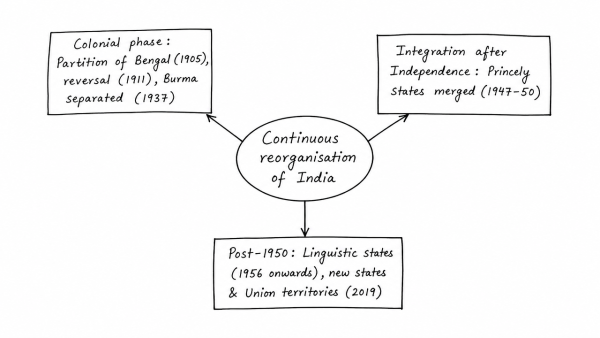
- Colonial phase: The British reshaped provinces for imperial control and administrative ease. The Partition of Bengal in 1905, its reversal in 1911, and the later separation of Burma in 1937 show that boundaries were treated as flexible administrative tools.
- Integration after Independence: Between 1947 and 1950, more than 550 princely states were merged into the Union. This was a major political reorganisation to build a unified nation out of fragmented territories.
- Linguistic reorganisation: The demand for states on language basis gained strength with Andhra State in 1953 and the States Reorganisation Act, 1956. Later, Bombay was divided into Gujarat and Maharashtra in 1960, and Punjab was reorganised in 1966 to create Haryana and the Union Territory of Chandigarh.
- Ethnic and tribal factors: Nagaland was created in 1963 to address Naga identity and insurgency. Meghalaya, Manipur and Tripura became states in 1972, while Mizoram and Arunachal Pradesh attained statehood in 1987.
- Development and governance: Chhattisgarh, Uttarakhand and Jharkhand were created in 2000 to address regional backwardness and administrative gaps. Telangana was formed in 2014 due to long-standing developmental imbalance.
- Recent changes: Jammu and Kashmir was reorganised into two Union territories in 2019, and Dadra and Nagar Haveli and Daman and Diu were merged in 2020 for better administration.
Constitutional Articles 2, 3 and 4 make this process simple and flexible, showing that India is an “indestructible Union of destructible States”. Thus, reorganisation remains an ongoing instrument to balance unity with diversity, and administration with identity.
Originally written on
September 3, 2026
and last modified on
September 3, 2026.