The performance of welfare schemes that are implemented for vulnerable sections is not so effective due to the absence of awareness and active involvement at all stages of the policy process. Discuss. (UPSC 2019)
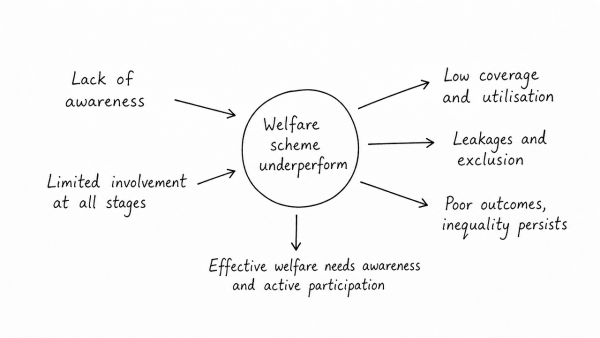
Welfare schemes for vulnerable sections often underperform not because of lack of intent, but because the intended users are not fully aware of their entitlements and are rarely involved in planning, delivery and review. In a welfare state, such gaps weaken the constitutional promise of dignity, equality and social justice.
- Constitutional basis: Articles 38, 39, 41 and 46 require the State to promote welfare, secure livelihood, provide public assistance and protect weaker sections. This makes participation and awareness essential, not optional.
- Awareness deficit: Many eligible people do not know how to register, apply or claim benefits. In welfare boards for construction workers, large numbers remain unaware of registration and available support. Digital systems have further excluded the elderly, disabled and remote tribal communities due to biometric and connectivity problems.
- Weak participation in the policy cycle:
- Design: schemes are often planned top-down, without local needs assessment.
- Implementation: citizens depend on intermediaries, creating delays and discrimination.
- Monitoring: social audits, Gram Sabha review and grievance redress remain weak, allowing leakages and elite capture.
- Rights-based approach: Treating people as rights-holders, not passive beneficiaries, improves accountability under schemes such as MGNREGA and NFSA.
- Improving outcomes: door-to-door outreach, simple ICT tools, community institutions, strong social audits and local participation can reduce exclusion and build trust.
Thus, poor performance of welfare schemes is closely linked to low awareness and limited public involvement. A participatory, rights-based and locally informed approach is necessary to make welfare delivery effective and inclusive.
Originally written on
September 1, 2026
and last modified on
September 1, 2026.