The North-East region of India has been infested with insurgency for a very long time. Analyze the major reasons for the survival of armed insurgency in this region. (UPSC 2017)
Armed insurgency in the North-East has endured due to a mix of geography, identity politics and governance failures, even after several accords.
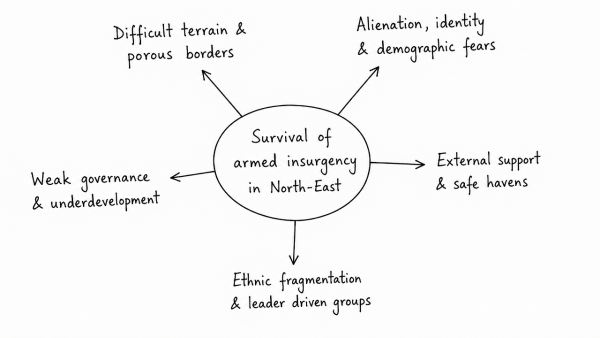
- Border and terrain: The region has long, porous borders, difficult hills and forests, and a vulnerable Indo-Myanmar frontier, allowing militants to move, hide and regroup.
- Alienation and identity: The Siliguri Corridor, historical neglect, ethnic fragmentation, land disputes and fears of demographic change fuel mistrust and armed mobilisation.
- Weak state capacity: Underdevelopment, unemployment, corruption, poor connectivity and limited local administration create space for parallel authority and recruitment.
- External and criminal support: Proximity to the Golden Triangle sustains arms, drugs and extortion networks; splinter groups and cross-border sanctuaries keep violence alive.
- Security approach: Heavy-handed policing and special laws sometimes deepen alienation and help insurgent propaganda.
Thus, insurgency survives because border vulnerability, ethnic anxieties, illicit economies and weak governance reinforce one another.
Originally written on
August 31, 2026
and last modified on
August 31, 2026.