The Nobel Prize in Physics of 2014 was jointly awarded to Akasaki, Amano and Nakamura for the invention of Blue LEDs in 1990s. How has this invention impacted the everyday life of human beings? (UPSC 2021)
The invention of the blue LED was a turning point because it completed the LED colour set and made efficient white light possible. This has changed lighting, electronics, health care and even agriculture in everyday life.
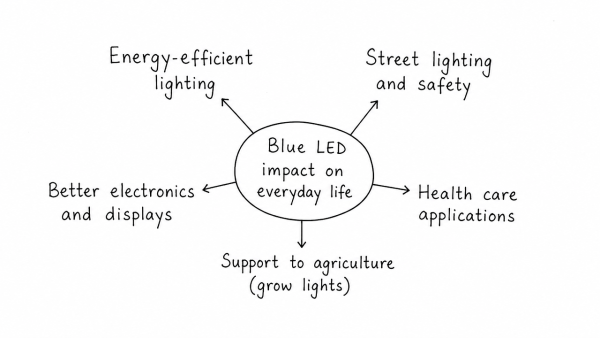
- Energy-efficient lighting: White LEDs use far less electricity than incandescent bulbs and last much longer. This has lowered household bills, reduced heat loss and cut demand for power generation.
- Street lighting and safety: LED streetlights are brighter, more durable and cheaper to maintain. Better lighting has improved road safety, reduced accidents and made public spaces safer at night.
- Digital devices: Blue LEDs made LED backlighting possible in flat-screen TVs, smartphones, laptops and monitors. This has enabled thinner, lighter and more energy-efficient devices.
- Healthcare use: Blue and related LED technologies are used in neonatal jaundice treatment, medical illumination and water sterilisation through ultraviolet LEDs.
- Agriculture and food production: Blue LEDs support indoor farming and vertical खेती by helping control plant growth, enabling crop production with less land and water.
| Impact area | Everyday effect |
| Homes | Cheaper and longer-lasting lighting |
| Transport | Safer roads and better visibility |
| Technology | Efficient screens and gadgets |
Thus, the blue LED has moved beyond a scientific breakthrough to become a basic part of modern life. Its greatest value lies in making light cheaper, cleaner and more versatile, while supporting safety, health and sustainable development.
Originally written on
September 3, 2026
and last modified on
September 3, 2026.