The newly tri-nation partnership AUKUS is aimed at countering China’s ambitions in the Indo-Pacific region. Is it going to supersede the existing partnerships in the region? Discuss the strength and impact of AUKUS in the present scenario. (UPSC 2021)
AUKUS is a major new security arrangement, but it is unlikely to supersede all existing partnerships in the Indo-Pacific. It is best seen as a hard-security, high-technology supplement to the region’s wider network of bilateral and minilateral ties.
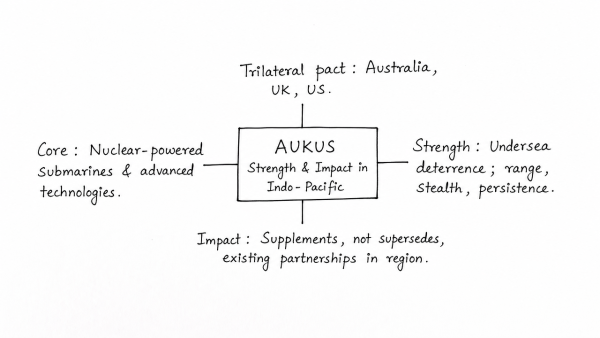
- Nature of AUKUS: It is a legally binding trilateral pact among Australia, the UK and the US, centred on nuclear-powered submarines and advanced technologies such as AI, quantum, cyber, hypersonics and undersea systems.
- Strategic strength: Its main value lies in undersea deterrence. Nuclear-powered submarines give range, stealth and persistence, helping counter China’s anti-access and area-denial capabilities in the Indo-Pacific.
- Operational impact: Rotational US and UK submarine presence in Australia, co-development of SSN-AUKUS, and faster tech sharing through export-control easing make AUKUS more than a symbolic forum.
- Not a substitute for QUAD: The QUAD remains a broader, flexible platform focused on maritime awareness, supply chains, infrastructure and resilience. AUKUS is narrower and more militarised.
- Not a substitute for Five Eyes: Five Eyes is an intelligence-sharing system, while AUKUS is about capability development and force integration.
- ASEAN centrality remains: ASEAN still anchors regional diplomacy and economic cooperation. AUKUS cannot replace that role, though it may cause strategic unease in Southeast Asia.
| Strengths | Limits |
| High-end defence industry integration | Long timelines and high costs |
| Strong deterrence against coercion | Nuclear proliferation concerns |
| Deep trust and interoperability | Possible regional polarisation |
Thus, AUKUS does not supersede existing partnerships; it sharpens the military balance in the Indo-Pacific. Its real impact will depend on timely delivery, industrial capacity and whether it can deter aggression without deepening instability.
Originally written on
September 2, 2026
and last modified on
September 2, 2026.