The New Economic Policy – 1921 of Lenin had influenced the policies adopted by India soon after independence. Evaluate. (UPSC 2014)
Lenin’s New Economic Policy (1921) was a pragmatic retreat that retained state control over key sectors while permitting limited private activity. India’s early post-1947 economic policy reflected this broad approach in a democratic setting.
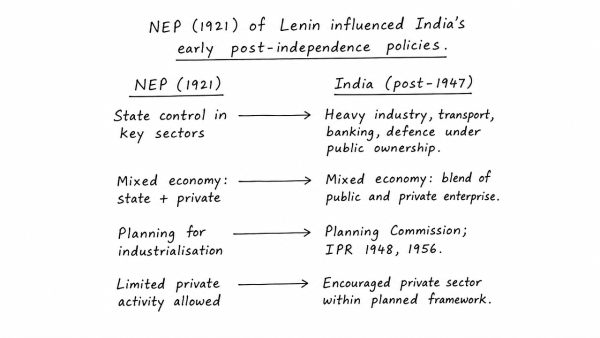
- State control: Nehru placed heavy industry, transport, banking and defence under public ownership.
- Mixed economy: India adopted a blend of public and private enterprise, echoing NEP’s pragmatic balance.
- Planning: The Planning Commission and the Industrial Policy Resolutions of 1948 and 1956 promoted state-led industrialisation and basic industries.
- Agrarian policy: India preferred land reforms and cooperatives, unlike Soviet collectivisation.
Yet the influence was limited: NEP was temporary and authoritarian, whereas India’s model was constitutional, long-term and adapted to democracy, federalism and social justice.
Originally written on
August 29, 2026
and last modified on
September 7, 2026.