The nature of economic growth in India in recent times is often described as jobless growth. Do you agree with this view? Give arguments in favour of your answer. (UPSC 2015)
India’s recent growth cannot be called wholly jobless, but it has certainly been job-poor in quality and inclusiveness. Output has risen strongly, yet employment growth has been slower, uneven, and heavily concentrated in low-productivity work.
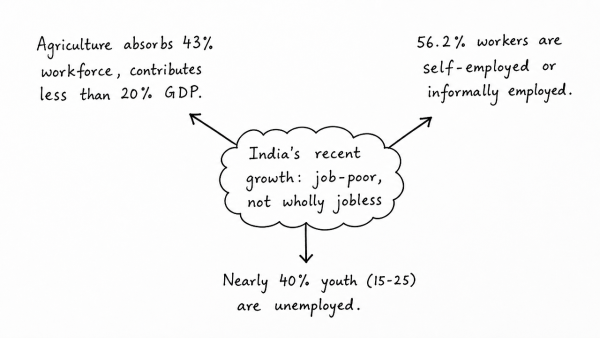
- Evidence for jobless growth: Agriculture still absorbs about 43% of the workforce while contributing less than 20% of GDP, showing disguised unemployment.
- Informality remains high: Around 56.2% of workers are self-employed or informally employed, while regular salaried jobs are only 23.6%.
- Youth distress persists: Nearly 40% of youth aged 15–25 are unemployed, and unemployment among urban youth remains high.
- Skill mismatch: Only 4.2% of the workforce has formal vocational or technical training, limiting access to modern industry jobs.
- NEET challenge: A very large number of young people are not in education, employment or training, reflecting weak labour absorption.
- However, growth is not entirely jobless: Official labour data show a fall in unemployment from 6.1% in 2017-18 to around 3.1% in 2025.
- Job creation is happening, but unevenly: Employment has expanded, especially through self-employment, construction, services, and some manufacturing.
- Female participation has improved: Rising female workforce participation indicates better labour market inclusion.
Thus, India’s growth is better described as employment-slow and quality-deficient, not fully jobless. The policy challenge is to shift workers from low-productivity informality to secure, skill-based, formal jobs.
Originally written on
August 30, 2026
and last modified on
August 30, 2026.