The National Commission for Protection of Child Rights has to address the challenges faced by children in the digital era. Examine the existing policies and suggest measures the Commission can initiate to tackle the issue. (UPSC 2025)
Children are increasingly exposed to cyberbullying, grooming, sexual abuse material, screen addiction and data exploitation. The National Commission for Protection of Child Rights must respond not only as a watchdog, but also as a standard-setter for safer digital childhoods.
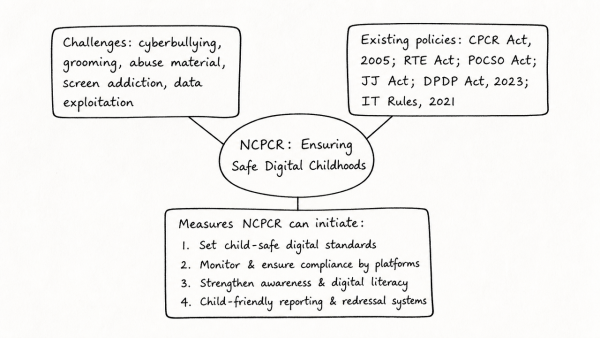
- Existing policy base: The CPCR Act, 2005 empowers NCPCR to monitor child rights. It also oversees the RTE Act, POCSO Act and JJ Act. The DPDP Act, 2023 protects children’s data through parental consent and bans profiling, tracking and targeted ads. The IT Rules, 2021 require intermediaries to remove unlawful child-harming content quickly.
- Gaps in implementation: Laws exist, but age verification, consent enforcement, reporting, and platform accountability remain weak. Many children also lack awareness of safe online behaviour and grievance systems.
- Measures NCPCR can initiate:
- Issue uniform child online safety guidelines for schools, EdTech and gaming platforms.
- Push for privacy-friendly age verification and strict parental consent checks.
- Run digital audits of school apps and learning platforms for data misuse and dark patterns.
- Strengthen child-friendly reporting through POCSO e-Box, e-BaalNidaan and local grievance desks.
- Create district-level cyber safety support teams with trained counsellors and child protection officers.
- Expand awareness on cyberbullying, grooming, deepfakes, password safety and screen discipline.
- Work with police, I4C, schools and platforms to flag CSAM, grooming patterns and repeat offenders early.
NCPCR should combine regulation, prevention and reporting. A child-centric digital ecosystem requires safer platforms, accountable institutions and informed parents, teachers and children.
Originally written on
September 5, 2026
and last modified on
September 5, 2026.