“The long sustained image of India as a leader of the oppressed and marginalized nations has disappeared on account of its newfound role in the emerging global order.” Elaborate. (UPSC 2019)
India’s foreign policy has changed from the idealism of Non-Alignment to a more pragmatic pursuit of strategic autonomy. This has reduced the visible rhetoric of anti-imperialist leadership, but it has not erased India’s concern for the Global South.
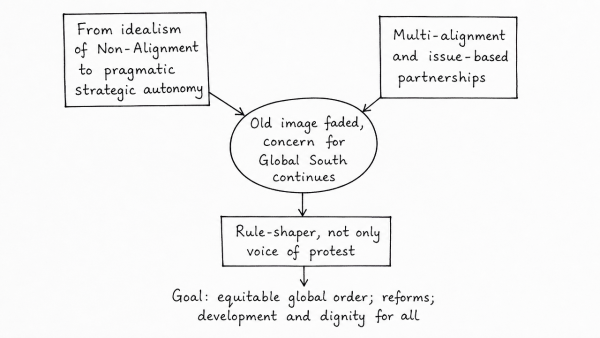
- Why the old image has faded: India now works through multi-alignment and issue-based partnerships, not bloc politics. Engagement in the Quad, i2U2 and iCET shows a stronger focus on security, technology and economic interests.
- Rule-shaper, not only voice of protest: India seeks a permanent seat in a reformed UN Security Council, greater say in global finance, and influence in setting rules rather than merely criticising unequal systems.
- Realism in external relations: India has kept energy and defence ties with Russia while deepening cooperation with the US and Europe. This reflects hard national interest, not a purely moral posture.
Yet, the leadership role has not disappeared: it has been redefined. India has pushed the African Union’s entry into the G20, hosted the Voice of Global South Summits, and proposed a Global Development Compact focused on debt, food security, trade capacity and concessional finance.
- New instruments of solidarity: India promotes digital public infrastructure, affordable vaccines, disaster relief, and climate justice through the ISA, CDRI and Global Biofuels Alliance.
- Development partnership: Through lines of credit, training and capacity-building, India offers a model different from coercive aid and debt dependence.
Therefore, India’s image as a champion of the oppressed has not vanished; it has shifted from ideological posturing to capability-based leadership. The challenge is to balance great-power ambitions with sustained commitment to the concerns of the Global South.