The jurisdiction of the Central Bureau of Investigation (CBI) regarding lodging an FIR and conducting probe within a particular state is being questioned by various States. However, the power of States to withhold consent to the CBI is not absolute. Explain with special reference to the federal character of India. (UPSC 2021)
The CBI’s power to investigate within a State lies at the intersection of criminal justice and federal autonomy. While States control police and public order under the State List, their power to deny consent to the CBI is not unlimited in a constitutional democracy governed by the rule of law.
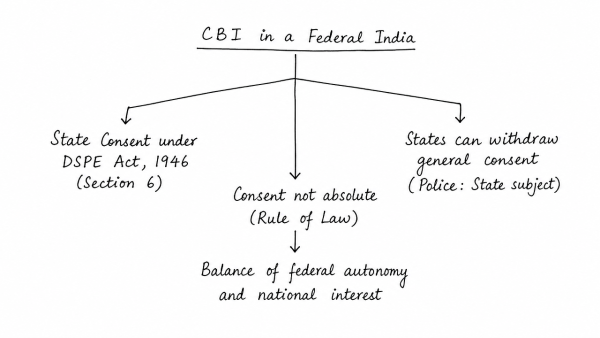
- Legal basis: The CBI functions under the DSPE Act, 1946. Section 6 requires State consent for exercise of CBI powers in that State, reflecting India’s quasi-federal structure.
- State autonomy: Since police is a State subject, States can withdraw general consent and insist on case-wise approval. This protects them against arbitrary central intrusion.
- But consent is not absolute:
- Judicial direction: Constitutional courts can order a CBI probe in exceptional cases to ensure fair investigation and protect fundamental rights.
- Central subjects and central employees: In offences under Central laws, especially involving Central Government staff, the CBI may act without State consent in appropriate situations.
- Pending investigations: Withdrawal of consent does not stop investigations already lawfully registered.
- Special territories: Consent is not needed in Union Territories and certain special jurisdictions.
- Inter-State crimes: Offences with cross-border and national ramifications may justify central investigation despite State objection.
- Federal balance: India’s federalism is not rigid; it is cooperative and pragmatic. The Union must secure integrity, probity and equal justice, while States must not be reduced to passive spectators.
Thus, State consent is an important federal safeguard, but it cannot override constitutional courts, central law, or the need to tackle serious inter-State and corruption-related offences. A balanced, transparent statutory framework for the CBI would strengthen trust and reduce friction in India’s federal system.
Originally written on
September 2, 2026
and last modified on
September 2, 2026.