The interlinking of rivers can provide viable solutions to the multi-dimensional inter-related problems of droughts, floods and interrupted navigation. Critically examine. (UPSC 2020)
Interlinking of rivers aims to move water from relatively water-rich basins to water-deficit ones through canals and reservoirs. In principle, it can ease drought, moderate floods and support inland navigation, but its success depends on hydrology, ecology and governance.
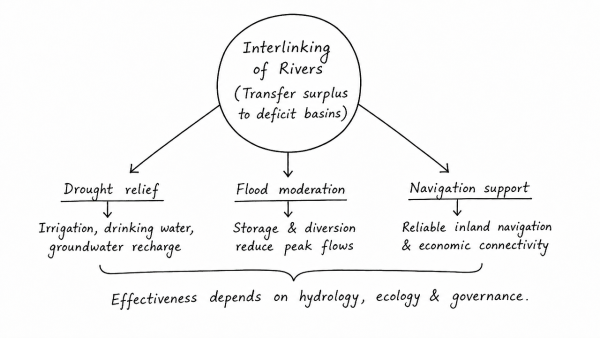
- Drought relief: Transfer to arid regions can support irrigation, drinking water and groundwater recharge; e.g., Ken-Betwa is projected to irrigate 10.62 lakh hectares and supply water to 62 lakh people.
- Flood moderation: Storage and diversion may reduce peak flows in flood-prone basins like the Kosi and parts of the Brahmaputra, lowering seasonal damage and loss of life.
- Navigation gains: Maintained flows can improve inland water transport, cut logistics costs and reduce dependence on roads and railways.
- Critical concerns: The notion of “surplus” water is uncertain under climate variability; rivers are dynamic systems, not transfer canals. Large projects submerge forests, disturb wildlife, alter sediment flow, affect deltas, fisheries and groundwater, and create interstate and rehabilitation disputes. Their high capital cost also competes poorly with watershed development, rainwater harvesting and micro-irrigation.
Therefore, river interlinking is only a partial, conditional solution and should be pursued selectively with basin-level planning, rigorous environmental assessment and priority to local water conservation.
Originally written on
September 2, 2026
and last modified on
September 2, 2026.