“The Indian party system is passing through a phase of transition which looks to be full of contradictions and paradoxes.” Discuss. (UPSC 2015)
India’s party system is in transition: it shows both consolidation and fragmentation, unity and fluidity.
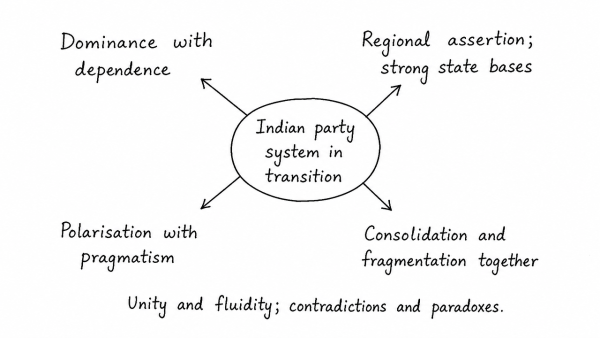
- Dominance with dependence: The BJP remains the largest party, yet its 2024 majority fell short and it needed NDA partners, marking a shift from single-party dominance to coalition politics.
- Regional assertion: Parties such as TMC, DMK and SP retain strong state bases, making the system increasingly federal and multi-level rather than fully national.
- Polarisation with pragmatism: National politics is sharper and more ideological, but alliances remain flexible and often convenience-driven, as seen in NDA and INDIA.
- Democracy with distortions: Participation is high, but money power, defections, weak internal democracy and centralised leadership continue to weaken representation.
Thus, the Indian party system reflects a paradox of national consolidation alongside regional fragmentation, suggesting both maturity and instability in its ongoing evolution. [Answer Updated: August 2026]
Originally written on
August 30, 2026
and last modified on
August 30, 2026.