The Indian Constitution has provisions for holding joint session of the two Houses of the Parliament. Enumerate the occasions when this would normally happen and also the occasions when it cannot, with reason thereof. (UPSC 2017)
The Constitution allows a joint sitting of Parliament mainly to resolve a legislative deadlock under Article 108. It is not a general device, and it differs from the joint meeting under Article 87 for the President’s address.
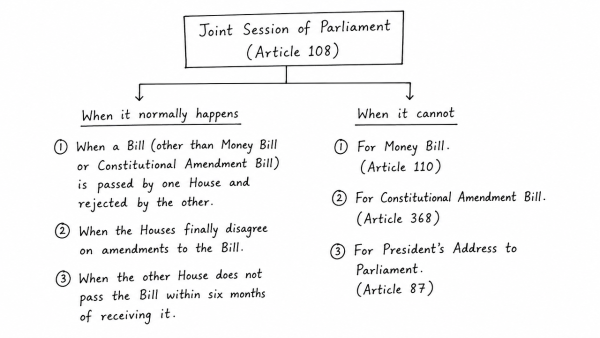
When it normally happens
- When a Bill other than a Money Bill or Constitutional Amendment Bill is passed by one House and rejected by the other.
- When the Houses finally disagree on amendments to the Bill.
- When the other House does not pass the Bill within six months of receiving it.
When it cannot happen
- Money Bills: the Rajya Sabha can only make recommendations within 14 days; hence no deadlock arises.
- Constitution Amendment Bills: each House must pass them separately by special majority; joint sitting is excluded.
- Non-Bill matters: Article 108 applies only to Bills, not to resolutions, motions or other business.
- Lok Sabha dissolution: if dissolved before the President notifies the joint sitting, the Bill lapses; if dissolved after notification, the joint sitting may still be held.
Thus, joint sitting is a narrow exception used only to break deadlock in ordinary legislation.
Originally written on
August 31, 2026
and last modified on
August 31, 2026.