“The incidence and intensity of poverty are more important in determining poverty than income alone.” In this context, analyse the latest United Nations Multidimensional Poverty Index Report. (UPSC 2020)
Income alone cannot fully explain poverty, as it ignores the multiple deprivations that trap households in hardship. The United Nations Multidimensional Poverty Index shows that incidence and intensity matter more because poverty is not only about how many people are poor, but also about how deeply they are poor.
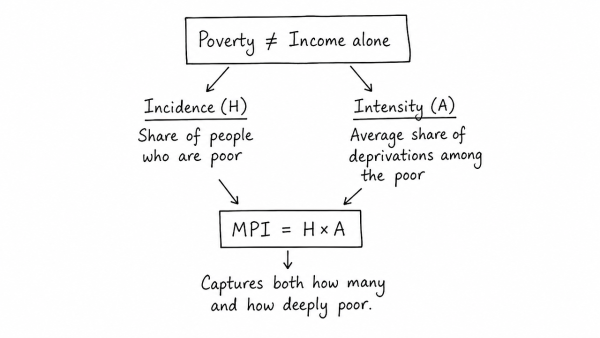
- What incidence and intensity mean: Incidence is the share of people who are poor. Intensity is the average share of deprivations faced by those who are poor. MPI combines both as MPI = H × A.
- Why this is superior to income poverty: A family may cross an income line and still lack nutrition, sanitation, electricity, housing, schooling or health care. Such hidden poverty is missed by income-only measures.
- Latest UN MPI findings: About 1.1 billion people across 109 countries live in acute multidimensional poverty. Over half are children. Nearly 80% of the poor face at least one climate hazard, showing how poverty and vulnerability overlap.
- Regional pattern: Poverty is concentrated in Sub-Saharan Africa and South Asia. Strikingly, many poor people live in middle-income countries, proving that growth alone does not remove deprivation.
- Key deprivations: Clean cooking fuel, housing and sanitation remain major deficits, which show the depth of poverty beyond income.
For policy, the MPI pushes governments towards targeted action on health, education, housing, water, energy and climate resilience. Thus, incidence tells us how widespread poverty is, while intensity shows how severe it is; together they give a far truer picture than income alone.
Originally written on
September 2, 2026
and last modified on
September 2, 2026.