“The Himalayas are highly prone to landslides.” Discuss the causes and suggest suitable measures of mitigation. (UPSC 2016)
The Himalayas are among the world’s most landslide-prone regions because they are young, fragile and tectonically active. Nearly 15% of India’s land is landslide-prone, and the Himalayas account for over 60% of such zones.
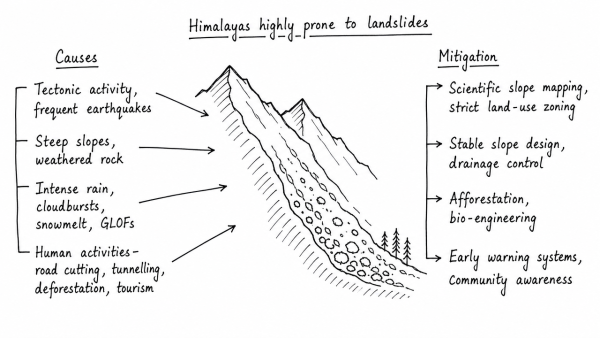
- Causes: Active plate collision, steep slopes, weathered rock, and frequent earthquakes weaken slope stability.
- Climate factors: Intense monsoon rain, cloudbursts, snowmelt and glacial lake outburst events saturate soil and trigger slope failure.
- Human factors: Road cutting, tunnelling, hydropower projects, deforestation, unplanned tourism and settlement on unstable slopes increase risk.
- Mitigation: Scientific slope mapping, strict land-use zoning and carrying capacity studies should guide all projects.
- Engineering measures: Retaining walls, drainage, rock bolting, bio-engineering and afforestation can stabilise slopes.
- Preparedness: Real-time monitoring, early warning systems, hazard databases and community awareness are essential.
Thus, landslides in the Himalayas are a natural but worsening hazard. Risk can be reduced only through a mix of careful planning, resilient infrastructure and ecosystem-based management.
Originally written on
August 30, 2026
and last modified on
August 30, 2026.