“The growth of cities as I.T. hubs has opened up new avenues of employment, but has also created new problems.” Substantiate this statement with examples. (UPSC 2017)
India’s IT hubs have become major growth centres, creating skilled employment and also generating serious urban stress.
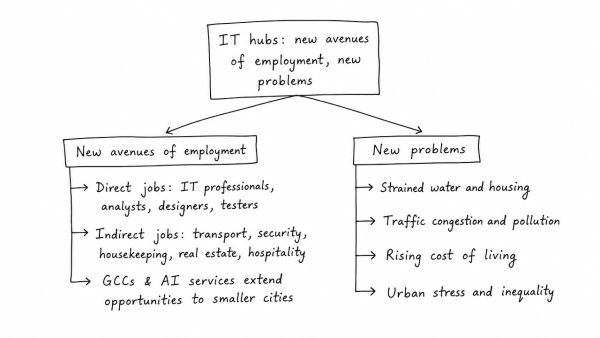
- Employment gains: Cities like Bengaluru, Hyderabad, Pune and Chennai have produced direct jobs for software engineers, data analysts, designers, testers and support staff. IT parks such as Electronic City, HITEC City and Hinjewadi have also created indirect work in transport, security, housekeeping, food services, real estate and hospitality. Expansion of GCCs and AI-related services has extended opportunities to smaller cities like Kochi, Coimbatore and Mangaluru.
- New problems: Rapid growth has strained water, housing and transport. Bengaluru’s 2024 water crisis exposed overdependence on groundwater and tankers. Traffic congestion in Bengaluru, Gurugram and Pune reflects infrastructure lag. Rising demand has pushed up rents and land prices, excluding lower and middle-income groups and encouraging informal sprawl. Encroachment of lakes, wetlands and green spaces has worsened flooding and reduced recharge, while IT-led consumption also increases solid waste and e-waste.
Thus, IT cities have opened new avenues of employment, but without planned urbanisation they also deepen congestion, inequality and environmental vulnerability.
Originally written on
August 31, 2026
and last modified on
August 31, 2026.