“The emergence of the Self-Help Groups (SHGs) in contemporary times points to the slow but steady withdrawal of the State from developmental activities.” Examine the role of the SHGs in developmental activities and the measures taken by the Government of India to promote the SHGs. (UPSC 2017)
The rise of Self-Help Groups (SHGs) does not show a simple withdrawal of the State. Rather, it reflects a shift from direct delivery to a facilitative role, where the State enables communities to manage development from below. SHGs have become important instruments of inclusive growth, especially for rural women and the poor.
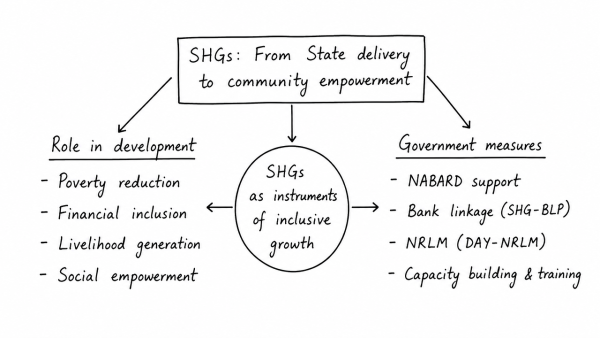
- Role in developmental activities
- Poverty reduction through savings, internal lending and access to micro-credit for livelihoods such as tailoring, dairying, food processing and petty trade.
- Financial inclusion by linking poor households with banks, improving credit access and reducing dependence on moneylenders.
- Women’s empowerment by building confidence, leadership, decision-making and collective bargaining power.
- Social change by raising awareness on education, health, nutrition, sanitation, domestic violence and child marriage.
- Support to local governance by helping members participate in Panchayats and community institutions.
- Resilience in crises by organising relief, community kitchens and local support networks.
- Government measures to promote SHGs
- Implementation of DAY-NRLM as the flagship mission for forming and nurturing SHGs through social mobilisation, training and livelihood support.
- Financial support through revolving funds, community investment funds, bank credit linkage and interest subvention on loans.
- Special initiatives such as Lakhpati Didi for sustainable income generation and Namo Drone Didi for technology-led rural services.
- Promotion of market access through branded outlets, e-commerce platforms and procurement support for women-led enterprises.
- Capacity building through community resource persons, digital records and skill training for enterprise development.
Thus, SHGs are not a sign of State abdication but of State reorientation. By enabling community-based institutions, the State has deepened participation, improved last-mile delivery and made development more inclusive and sustainable.
Originally written on
August 31, 2026
and last modified on
August 31, 2026.