“The emergence of Fourth Industrial Revolution (Digital Revolution) has initiated e-Governance as an integral part of government.” Discuss. (UPSC 2020)
The Fourth Industrial Revolution has moved e-Governance from a support tool to the core of government. By combining AI, IoT, big data, cloud and blockchain, it enables real-time, citizen-centric and data-driven administration.
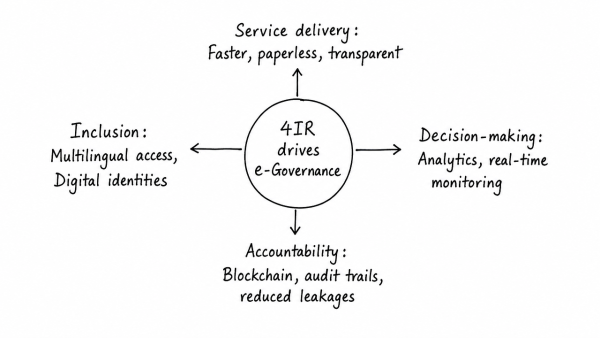
- Service delivery: DigiLocker, UPI and DBT have made public services faster, paperless and more transparent.
- Decision-making: PRAGATI and analytics-based monitoring improve coordination, reduce delays and detect leakages in welfare schemes.
- Inclusion: AI-led multilingual platforms like Bhashini expand access for diverse users, while digital identities support seamless G2C, G2B and G2G services.
- Accountability: Blockchain and digital audit trails strengthen trust, reduce corruption and improve traceability.
However, the model also raises concerns of digital divide, privacy, cyber threats and algorithmic bias. Therefore, 4IR has made e-Governance integral to modern government, but its success depends on secure infrastructure, digital literacy and equitable access.
Originally written on
September 2, 2026
and last modified on
September 2, 2026.