The concept of Mid Day Meal (MDM) scheme is almost a century old in India with early beginnings in Madras Presidency in pre-independent India. The scheme has again been given impetus in most states in the last two decades. Critically examine its twin objectives, latest mandates and success. (UPSC 2013)
The Mid Day Meal scheme, begun in Madras in 1920 and later expanded nationwide, remains one of India’s most important school welfare programmes. It tackles both hunger and poor school participation, especially among children from disadvantaged families.
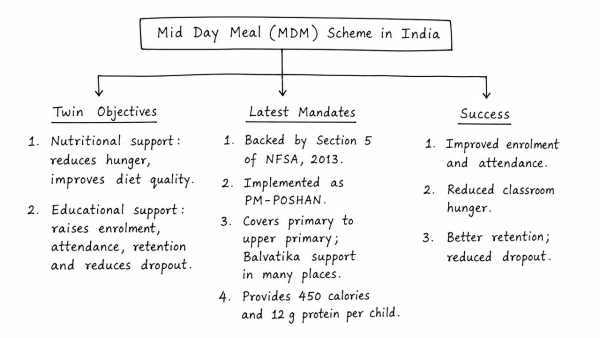
- Twin objectives:
- Nutritional support: reduces classroom hunger and improves diet quality.
- Educational support: raises enrolment, attendance and retention, and reduces dropout.
- Latest mandates:
- Now backed by Section 5 of NFSA, 2013.
- Implemented as PM-POSHAN, covering children from primary to upper primary, with Balvatika support in many places.
- Prescribes 450 calories and 12 g protein for primary, and 700 calories and 20 g protein for upper primary.
- Includes fortified rice, social audits, digital tracking, school nutrition gardens and community participation.
- Success and limits: It has improved attendance, gender equity and social mixing, but quality, leakage, hygiene, delayed funds and caste discrimination still weaken outcomes.
Thus, the scheme is successful as a welfare and education tool, but its full impact depends on strong monitoring, better infrastructure and reliable funding.
Originally written on
August 28, 2026
and last modified on
September 7, 2026.