The concept of cooperative federalism has been increasingly emphasized in recent years. Highlight the drawbacks in the existing structure and the extent to which cooperative federalism would answer the shortcomings. (UPSC 2015)
Cooperative federalism means the Centre and States function as partners, essential as India faces fiscal stress, legal conflicts and mistrust.
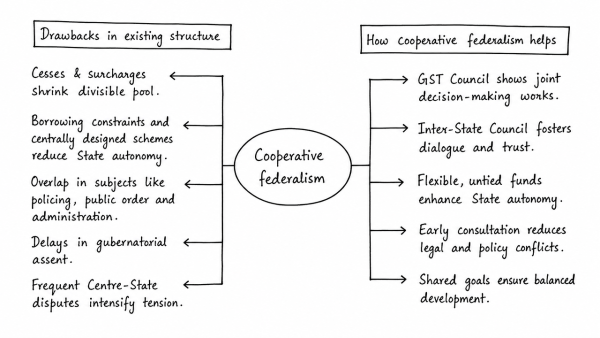
- Drawbacks in the present structure: cesses and surcharges shrink the divisible pool, limiting untied transfers to States.
- Borrowing constraints and centrally designed schemes reduce State autonomy, especially for poorer States.
- Overlap in subjects like policing, public order and administration creates friction.
- Delays in gubernatorial assent and frequent Centre-State disputes intensify political tension.
- How cooperative federalism helps: the GST Council shows joint decision-making can balance national and State interests.
- The Inter-State Council and Zonal Councils can replace confrontation with dialogue and coordination.
- It enables better sharing of tax powers, flexible schemes and greater sensitivity to regional needs.
Thus, while it cannot remove all structural imbalances, cooperative federalism can reduce adversarial politics, improve policy outcomes and make governance more inclusive.
Originally written on
August 30, 2026
and last modified on
August 30, 2026.