“The centre of global trade is gradually shifting from the Atlantic region to the Indo-Pacific region.” Examine this statement. (UPSC 2026)
The balance of global trade is moving eastward. The Indo-Pacific now combines scale, manufacturing strength, shipping dominance and market demand, making it the most dynamic trade space; however, the Atlantic still retains major financial and institutional power, so the shift is gradual, not complete.
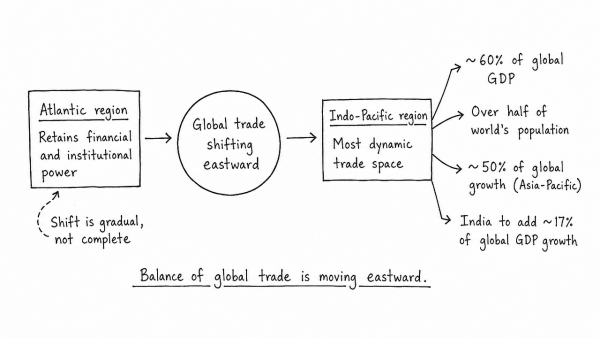
Drivers of Indo-Pacific rise
- The region accounts for about 60% of global GDP and over half the world’s population, creating the largest base for production and consumption.
- Asia-Pacific contributes nearly 50% of global growth; India alone is expected to add around 17% of global GDP growth.
- East Asia remains the main engine of trade expansion, led by China, South Korea and other manufacturing economies.
Trade and maritime advantages
- RCEP links 15 economies and covers about 30% of global GDP and population, deepening regional value chains.
- CPTPP and IPEF reflect a shift towards modern rules on supply chains, services and digital trade.
- Over 60% of global maritime trade passes through the Indo-Pacific, and chokepoints like the Strait of Malacca make it central to energy and goods flows.
Why the Atlantic still matters
- The US dollar remains the key reserve and settlement currency.
- Wall Street, SWIFT and Bretton Woods institutions continue to shape global finance.
- Atlantic powers still influence standards, technology and security.
Thus, global trade is being rebalanced towards the Indo-Pacific on the strength of growth, supply chains and connectivity, while the Atlantic retains financial primacy in key areas.
Originally written on
September 5, 2026
and last modified on
September 5, 2026.