“The Central Administrative Tribunal which was established for redressal of grievances and complaints by or against central government employees nowadays is exercising its powers as an independent judicial authority.” Explain. (UPSC 2019)
The Central Administrative Tribunal was created to provide speedy and specialised redressal of disputes involving central government employees. Over time, it has moved beyond a mere service body and now functions much like an independent judicial forum in service matters.
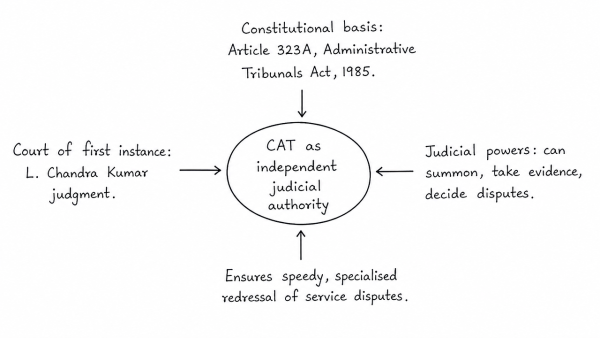
- Constitutional basis: Article 323A and the Administrative Tribunals Act, 1985 give CAT power over recruitment and service conditions of public servants.
- Court of first instance: In L. Chandra Kumar, the Supreme Court held that service disputes must first go to CAT, making it the primary adjudicator.
- Judicial powers: CAT can hear evidence, decide questions of law, and has contempt powers similar to a High Court under Section 17.
- Independence: Its benches have judicial members, service safeguards, and a specialised procedure, reducing executive dominance.
However, CAT is not a substitute for High Courts, as its decisions remain subject to judicial review under Articles 226 and 227. Thus, CAT is an independent adjudicatory authority in practice, though within the constitutional supervision of the higher judiciary.
Originally written on
September 1, 2026
and last modified on
September 1, 2026.