“The Attorney-General is the chief legal adviser and lawyer of the Government of India.” Discuss. (UPSC 2019)
The Attorney-General for India is indeed the chief legal adviser and the main lawyer of the Union Government. Article 76 creates the office and gives it a dual role: advising the Government on legal matters and appearing on its behalf before courts.
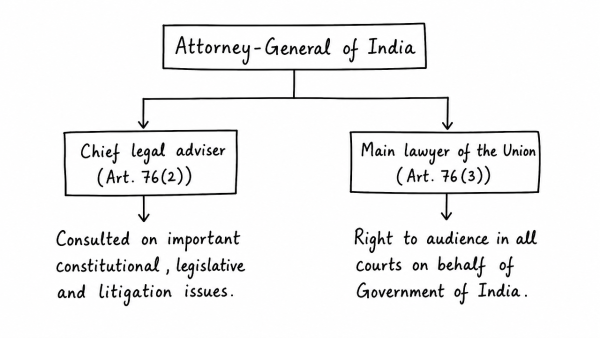
- Chief legal adviser: Under Article 76(2), the AG is consulted on important constitutional, legislative and litigation issues. This helps the Government test the legality of its actions before taking policy decisions.
- Main lawyer of the Union: Under Article 76(3), the AG has the right to audience in all courts in India and represents the Union in major cases, especially in the Supreme Court and constitutional matters.
- Parliamentary role: Under Article 88, the AG may take part in the proceedings of both Houses of Parliament and committees, but cannot vote. This strengthens legal scrutiny of law-making.
- Constitutional status: The AG is appointed by the President and holds office during the pleasure of the President. He is not a civil servant or a full-time government employee, and may practise privately subject to restrictions.
The office therefore combines legal advice, court advocacy and parliamentary participation, making it a key link between law, policy and constitutional governance.
- Limitations: The AG cannot advise or act against the Government of India and requires permission in some private engagements. He is assisted by the Solicitor-General and Additional Solicitors-General.
Thus, the statement is correct, but the AG is more than a government lawyer. He is a constitutional authority whose duty is to aid the State in upholding legality, fairness and sound constitutional practice.
Originally written on
September 1, 2026
and last modified on
September 1, 2026.