The ancient civilization in Indian sub-continent differed from those of Egypt, Mesopotamia and Greece in that its culture and traditions have been preserved without a breakdown to the present day. Comment. (UPSC 2015)
The statement is largely correct. India’s civilisation shows remarkable continuity because its culture was not tied only to dynasties or capitals, but to living social, religious and linguistic traditions. Yet continuity does not mean sameness; Indian society has changed through reform, assimilation and regional diversity.
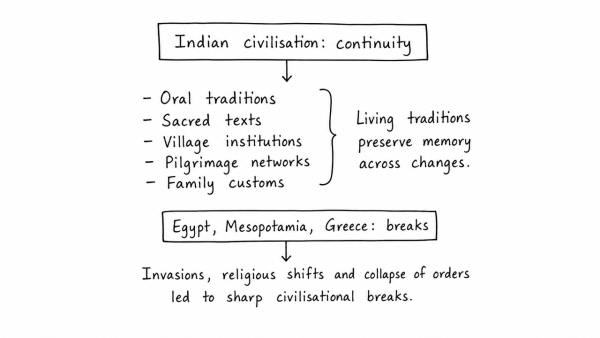
- India’s continuity: Oral traditions, sacred texts, village institutions, pilgrimage networks and family customs helped preserve memory across political changes.
- Unlike Egypt, Mesopotamia and Greece: Their ancient scripts, religions and urban orders were broken by repeated invasions and major religious transitions, leading to sharp civilisational breaks.
- Indian resilience: Even after Mauryas, Mughals and the British, core ideas like dharma, ritual, caste, vernacular culture and local self-rule survived and adapted.
- Archaeological support: Sites such as Vadnagar, Rakhigarhi and Keeladi indicate long settlement and cultural transition rather than total collapse.
Thus, India stands out for civilisational continuity, but this was a dynamic continuity marked by renewal, regional variation and selective change, not a frozen tradition.
Originally written on
August 29, 2026
and last modified on
August 29, 2026.