‘Terrorism is emerging as a competitive industry over the last few decades.’ Analyse the above statement. (UPSC 2016)
Terrorism has increasingly acquired the traits of a competitive industry. Groups now operate like rival firms: they raise funds, build brands, recruit talent and fight for market share in violence, publicity and territory.
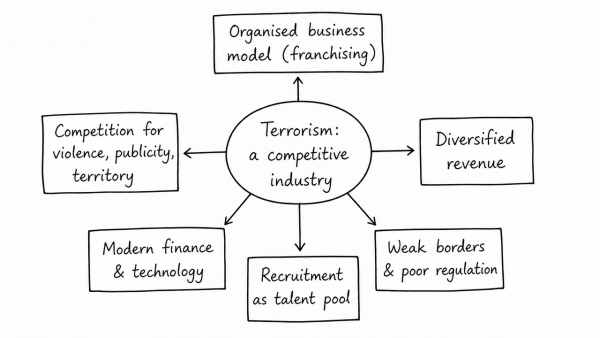
- Organised business model: Terror outfits use franchising and affiliate networks. Central groups such as IS and Al-Qaeda lend their brand to local branches, giving them autonomy while keeping global identity.
- Diversified revenue: They earn through drug trade, illegal mining, human smuggling, kidnapping for ransom and extortion. Weak borders and poor regulation help them sustain operations.
- Modern finance and logistics: Terrorists mix hawala, shell firms and digital channels, including privacy coins and online crowdfunding. They also use drones, encrypted apps and fake online content for propaganda.
- Outbidding and competition: Rival groups carry out more brutal and spectacular attacks to attract recruits, funds and media attention. This creates an escalation spiral.
- Territorial rivalry: Control over borderlands, smuggling routes and resource-rich areas gives access to taxes and illicit markets, deepening conflict.
Thus, terrorism today is not only ideological violence; it is also an adaptive, profit-seeking and brand-driven enterprise.
However, ideology remains central. The “industry” works because fear, grievance and radical beliefs supply manpower and legitimacy. Effective response needs intelligence sharing, financial tracking, cyber monitoring and strong international coordination.
Originally written on
August 31, 2026
and last modified on
August 31, 2026.