Taxila university was one of the oldest universities of the world with which were associated a number of renowned learned personalities of different disciplines. Its strategic location caused its fame to flourish, but unlike Nalanda, it is not considered as a university in the modern sense. Discuss. (UPSC 2014)
Taxila was among the earliest great seats of learning in ancient India. It drew students and teachers from across Asia and became famous for medicine, grammar, statecraft and military science.
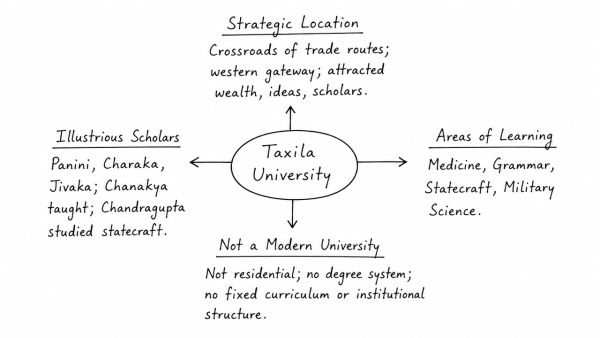
- Illustrious scholars: Panini, Charaka and Jivaka were linked with Taxila. Chanakya taught there, and Chandragupta Maurya is said to have studied statecraft under him.
- Strategic location: Situated at the crossroads of major trade routes and the western gateway to the subcontinent, it attracted wealth, ideas and scholars from Persia, Central Asia and Greece.
- Why not a modern university: Taxila was not a single organised institution. It was a cluster of independent teachers’ schools, without one campus, central authority, fixed admission rules, common curriculum, regular examinations or degrees.
- Contrast with Nalanda: Nalanda had a planned campus, central administration, a library system, and a structured residential and academic framework.
Thus, Taxila was a renowned centre of higher learning, but in form it was closer to a network of gurukulas than a university in the modern sense.
Originally written on
August 29, 2026
and last modified on
September 7, 2026.