Taking the example of pastoralist communities like the Maldharis, analyze how the degradation of common property rangelands impacts traditional social safety nets in rural India.
Pastoralist communities such as the Maldharis depend on common property rangelands for fodder, water and mobility. When these commons degrade, the loss is not only ecological; it breaks the informal support systems that have long protected rural households from risk.
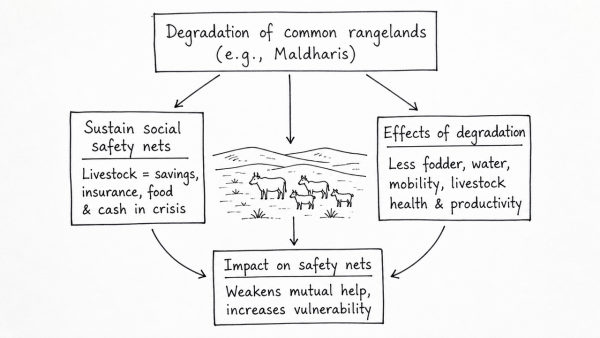
- How rangelands sustain social safety nets
Common grazing lands spread risk across the community. Livestock act as savings, insurance and a source of milk, ghee and cash during crop failure, illness or debt. - Effects of degradation
Encroachment, climate stress, invasive species and restrictive land use reduce pasture quality and force longer migrations. This raises costs, causes livestock deaths and lowers herd productivity, weakening the main buffer against poverty. - Erosion of community cohesion
Scarcer resources create conflict over grazing and water, weaken collective decision-making and reduce mutual help in herding, loan support and crisis sharing. Traditional authority systems also lose strength. - Impact on vulnerable groups
Women lose economic control when milk and small savings decline. Children face interrupted schooling and poor nutrition, while young people move away from pastoral life, causing loss of indigenous knowledge. - Wider rural consequences
As pastoral households sell animals or borrow at high interest, local resilience falls. Degraded commons also reduce ecological services that support nearby farming, such as manure supply and landscape stability.
| Key point | Implication |
| Healthy commons | Livestock-based insurance, cooperation and inter-generational continuity |
| Degraded commons | Debt, migration stress, weakened kinship support and cultural loss |
Thus, degradation of rangelands converts a community safety net into a source of insecurity. Protecting commons through secure grazing rights, community management and restoration is essential for both pastoral livelihoods and rural resilience.
Originally written on
September 13, 2026
and last modified on
September 13, 2026.