Taking the example of circular economy, discuss how ‘Urban Mining’ can mitigate critical mineral supply shocks. Why has recycling failed to scale up in India?
Circular economy turns waste into a resource, and urban mining applies this idea to cities. By recovering critical minerals from e-waste, end-of-life vehicles, batteries, tyres and construction waste, India can ease pressure on imported raw materials and build supply resilience.
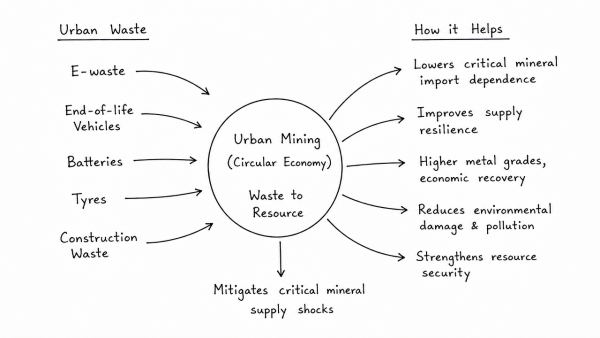
- How it helps: It cuts dependence on geopolitically concentrated imports, especially for lithium, cobalt, nickel and rare earths.
- Strategic value: Urban waste contains higher grades of some metals than natural ore, making recovery economically attractive in many cases.
- Environmental gain: It reduces land damage, energy use and pollution from fresh mining.
Why recycling has not scaled in India: formal collection systems are weak, the informal sector dominates, and high-purity processing technology is limited. Enforcement of EPR rules remains uneven, product design is not recycling-friendly, and private investment is cautious because returns are uncertain. Low source segregation, poor data and weak consumer awareness further reduce feedstock for formal recyclers.
Thus, urban mining can support mineral security, but only if India strengthens collection, technology, standards and incentives.