Taking example of the 2004 Tsunami Core Group, explain how the Quad’s HADR framework has evolved. Why is the “100-Day Window” concept vital?
The 2004 Indian Ocean tsunami showed that the Quad could act fast for humanitarian relief. The informal Tsunami Core Group, of the US, Japan, India and Australia, used military assets and logistics to deliver aid quickly, proving the value of coordinated disaster response.
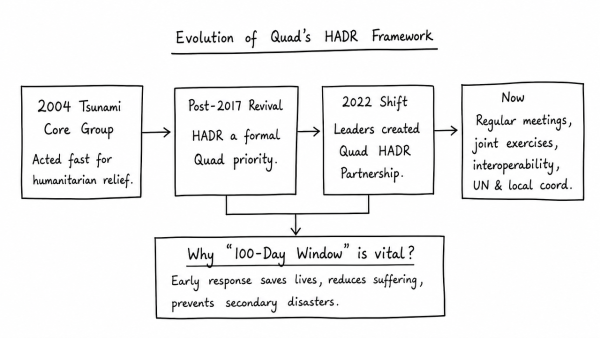
- From ad hoc to institutionalised: After revival post-2017, HADR became a formal Quad priority.
- 2022 shift: Leaders created the Quad HADR Partnership in Tokyo and later issued guidelines to operationalise it.
- Now: The framework stresses regular meetings, joint tabletop exercises, interoperability, and coordination with the UN, local authorities and NGOs.
- Why 100-Day Window matters: It covers the crucial early phase after a disaster, when rescue, medical care, logistics and damage control shape survival and recovery.
- Policy value: It demands pre-positioned supplies, faster decision-making and seamless communication before gaps widen.
Thus, the Quad’s HADR has moved from crisis-driven cooperation to a rules-based, prepared and practice-led mechanism for the Indo-Pacific.
Originally written on
September 12, 2026
and last modified on
September 12, 2026.