Taking example of recent filovirus outbreaks, discuss how ecological degradation accelerates zoonotic spillover. Why is the “One Health” framework indispensable for modern disaster management?
Recent filovirus outbreaks show that zoonotic disease is not only a medical event, but also an ecological one. Ebola and Marburg spillovers in Africa have repeatedly followed forest loss, wildlife disturbance and closer contact between people and reservoir hosts such as fruit bats.
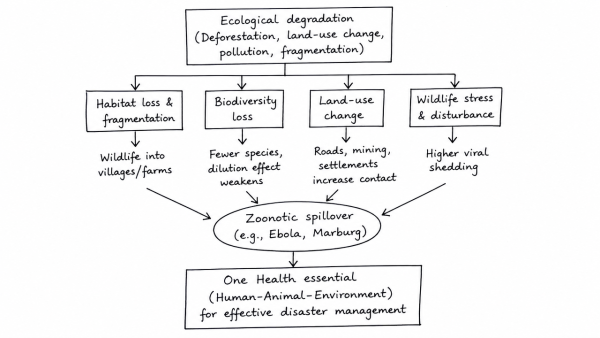
- How ecological degradation speeds spillover
- Deforestation and fragmentation: Clearing forests for farming, mining, timber and settlement pushes wildlife into villages and farms, raising human exposure.
- Biodiversity loss: Simplified ecosystems favour a few hardy species, including pathogen carriers, and weaken the natural “dilution effect”.
- Land-use change: New roads, plantations and urban edges create repeated human-animal interfaces where infection can cross species barriers.
- Climate stress: Droughts, floods and heat alter animal movement, damage sanitation and intensify contact between humans, livestock and wildlife.
- Hunting and bushmeat: Handling, butchering and consuming wild animals provide direct routes for viral transmission.
- Why One Health is indispensable
- It links human, animal and environmental health, which is essential because spillover begins at their interface.
- It enables joint surveillance, faster outbreak detection and shared risk assessment across forests, farms and hospitals.
- It improves preparedness for compound disasters such as epidemics, climate shocks and food insecurity.
- It supports coordinated response, from wildlife monitoring and veterinary action to community awareness and clinical care.
- It also strengthens policy coherence on AMR, land use, biodiversity and disaster management.
Thus, ecological protection is disease prevention. In a world of changing climates and shrinking habitats, One Health is not optional; it is the basic framework for anticipating, managing and recovering from modern disasters.
Originally written on
September 15, 2026
and last modified on
September 15, 2026.