Since the decade of the 1920s, the national movement acquired various ideological strands and thereby expanded its social base. Discuss. (UPSC 2020)
The national movement in the 1920s moved beyond a narrow elite politics and became a broad popular upsurge. It absorbed different ideologies, each linking freedom with a distinct social agenda, and this widened its reach across class, caste, gender and region.
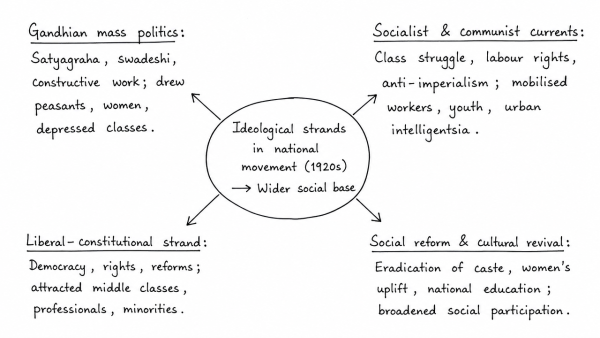
- Gandhian mass politics: Satyagraha, non-violence, swadeshi and constructive work turned nationalism into a people’s movement. It drew peasants, artisans, women and the depressed classes through Champaran, Kheda and Bardoli, while also stressing untouchability removal and village uplift.
- Socialist and communist currents: Class struggle, anti-imperialism and labour rights gave the movement a sharper economic edge. The CPI, AITUC, CSP and AIKS mobilised industrial workers, trade unionists and landless peasants, especially in the 1930s.
- Revolutionary nationalism: Groups like HRA and later HSRA inspired youth and students by combining armed resistance with radical ideas. This kept the anti-colonial struggle alive and attracted urban educated sections.
- Anti-caste and depressed classes’ assertion: Ambedkar’s politics shifted attention to social justice, equality and dignity. Movements such as Mahad Satyagraha politically awakened Scheduled Castes and pressed the Congress to address caste oppression.
- Women’s mobilisation: Organisations like the AIWC and leaders such as Sarojini Naidu and Kamaladevi Chattopadhyay brought women into picketing, protests and leadership, making nationalism socially inclusive.
- Business support: Swadeshi also appealed to Indian industrialists and traders, who backed indigenous enterprise and gave the movement financial strength.
Thus, the 1920s marked a decisive ideological broadening of nationalism. By combining political freedom with social reform, economic justice and mass participation, the movement became truly all-India in character.
Originally written on
September 2, 2026
and last modified on
September 2, 2026.