Should the pursuit of carbon credits and clean development mechanisms set up under UNFCCC be maintained even though there has been a massive slide in the value of a carbon credit? Discuss with respect to India’s energy needs for economic growth. (UPSC 2014)
Yes, the pursuit should continue, but with stronger rules and a clear focus on India’s development needs. The collapse in carbon credit prices showed the weaknesses of the old CDM: weak additionality, excess supply and falling demand. Yet the basic idea of rewarding low-carbon action remains useful for a growing economy.
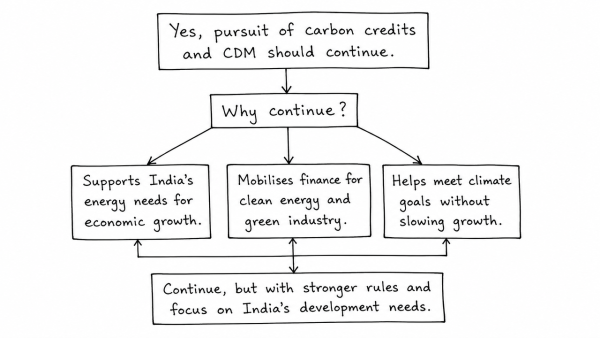
- For India’s energy growth: Rapid industrialisation and rising power demand require huge investment. Carbon markets can mobilise private finance for renewables, energy efficiency, green hydrogen and cleaner industry without slowing growth.
- For climate goals: A well-designed market helps India cut emissions intensity while meeting its NDC and long-term net-zero pathway.
- For market quality: Under Paris Agreement Article 6, tighter baselines, additionality tests and corresponding adjustments can reduce double counting and restore credibility.
- For competitiveness: A domestic carbon market can also prepare exporters for carbon-linked trade barriers.
Therefore, carbon credits and development mechanisms should be maintained, but only as high-integrity tools that support, not constrain, India’s economic growth and energy security.
Originally written on
August 29, 2026
and last modified on
August 29, 2026.