“Right of movement and residence throughout the territory of India are freely available to the Indian citizens, but these rights are not absolute.” Comment. (UPSC 2022)
Article 19(1)(d) and 19(1)(e) confer on Indian citizens the freedom to move freely and reside anywhere in India. These rights strengthen unity, mobility and equal access to opportunities, but they are not unlimited.
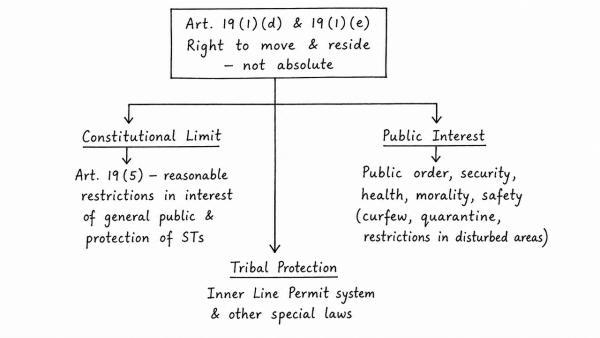
- Constitutional limits: Article 19(5) permits reasonable restrictions in the interests of the general public and for the protection of Scheduled Tribes.
- Public interest: Movement may be curbed for public order, security, health, morality or safety, such as curfew, quarantine or restrictions in disturbed areas.
- Tribal protection: Special laws like the Inner Line Permit system and provisions under the Fifth and Sixth Schedules protect tribal land, culture and identity.
- Judicial control: Restrictions must be reasonable, proportionate and backed by law; arbitrary externment or surveillance can violate fundamental rights.
Thus, these freedoms are broad but not absolute. The Constitution balances individual liberty with social order, national security and the rights of vulnerable communities.
Originally written on
September 3, 2026
and last modified on
September 3, 2026.